
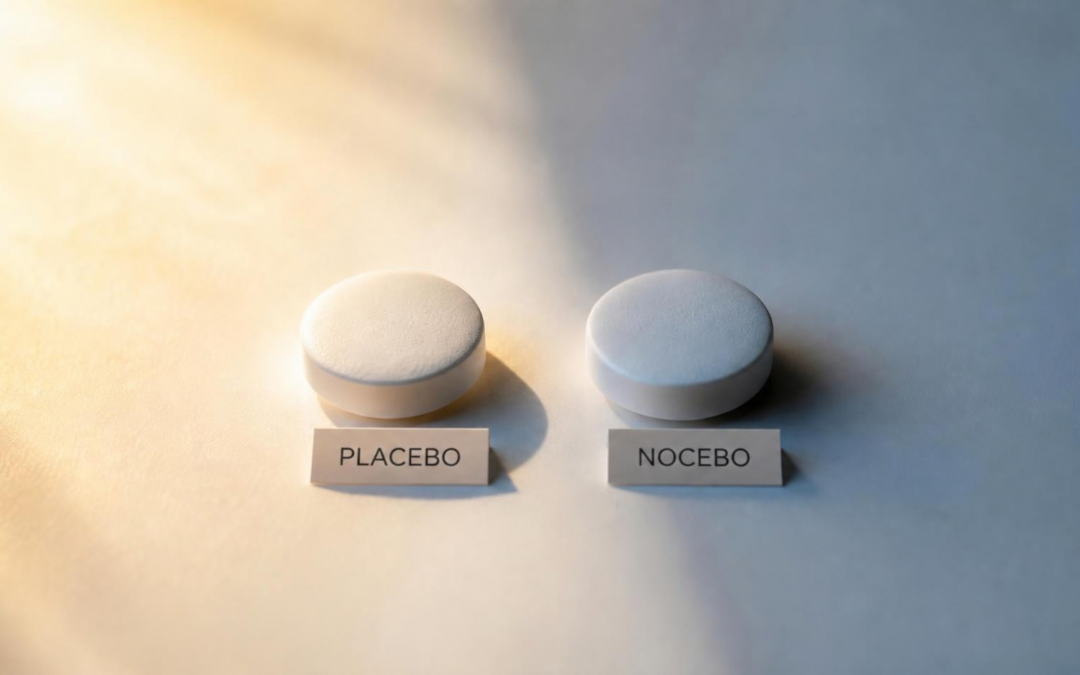
Anyone taking a medicine generally expects their symptoms to improve. In fact, this expectation alone can have a measurable impact on a person’s well-being, even if the medicine contains no active ingredient at all. This phenomenon is known as the placebo effect. Less well known, but equally significant, is its counterpart: the nocebo effect. In this case, negative expectations can lead to symptoms being perceived as more severe or even to new symptoms arising. Both effects demonstrate impressively just how closely the body and mind are interconnected.
The term “placebo” comes from Latin and literally means “I shall please”. In medicine, a placebo refers to a treatment containing no pharmacologically active ingredient. Nevertheless, placebos can bring about genuine changes. Studies show that, for example, pain, nausea or certain functional symptoms can improve with placebo treatment. Improvements have also been observed in sleep disorders following placebo treatment. However, the extent of such effects depends, amongst other things, on the specific condition, the symptoms under investigation and the treatment context. This is by no means merely imagination. Modern imaging techniques have demonstrated that placebo effects can be linked to measurable changes in the brain. This has been particularly well studied in the context of pain: positive expectations can activate the body’s own pain-relief processes. Among other things, neurotransmitters such as endorphins may play a role in this, helping to alleviate pain.
It is not the placebo itself that is crucial to the placebo effect, but the context of the treatment. The expectation of a positive outcome, trust in the person providing the treatment, and previous experiences with therapies all play an important role. Learning processes and the type of treatment can also influence expectations and placebo effects. In some studies, for example, stronger placebo responses have been observed with injections than with tablets, although this is not necessarily justified.
On the opposite side, we find the nocebo effect. The term is derived from the Latin “nocere”, which means “to harm”. In this context, negative expectations can contribute to a deterioration in a person’s state of health or to the onset of undesirable symptoms. A classic example is package leaflets or information sessions about possible adverse effects. Of course, comprehensive information about risks is medically necessary and important. However, studies show that information about possible side effects can give rise to negative expectations and thereby contribute to certain symptoms being perceived more frequently or more intensely. The expectation alone can contribute to normal bodily sensations being perceived more intensely and interpreted as symptoms.
However, the nocebo effect does not mean that those affected are “imagining” their symptoms. The symptoms are real and may be accompanied by measurable physical changes. Just like with placebo, this has been particularly well studied in relation to pain: negative expectations can influence how pain is processed and contribute to pain being perceived as more intense.
Both effects are of great significance in medical practice. A relationship of trust between doctor and patient, clear communication and realistic yet positive expectations can support the success of treatment. At the same time, patients should be given honest information about potential risks without causing unnecessary anxiety. The way in which information is conveyed can make a significant difference in this regard.
Placebo and nocebo effects highlight the fact that any treatment goes beyond the mere effect of a medicine. Expectations, experiences and communication with healthcare professionals have a significant influence on how patients experience treatments. This knowledge can help to make treatments more successful and reduce potential adverse effects.
In everyday life, it can be helpful to keep track of medicines and treatments. Digital tools such as the mediteo app help users to reliably record their intakes and organise their medication more effectively.
Sources
-
Benedetti, F. (2014). Placebo Effects: Understanding the Mechanisms in Health and Disease (2. Auflage). Oxford University Press. Placebo Effects: Understanding the Mechanisms in Health and Disease
-
Benedetti, F., Carlino, E., & Pollo, A. (2011). How placebos change the patient’s brain. Neuropsychopharmacology, 36(1), 339–354. https://doi.org/10.1038/npp.2010.81
-
Colloca, L., & Miller, F. G. (2011). Harnessing the placebo effect: The need for translational research. Philosophical Transactions of the Royal Society B: Biological Sciences, 366(1572), 1922–1930. Harnessing the placebo effect: the need for translational research
-
Enck, P., Bingel, U., Schedlowski, M., & Rief, W. (2013). The placebo response in medicine: Minimize, maximize or personalize? Nature Reviews Drug Discovery, 12(3), 191–204. https://doi.org/10.1038/nrd3923
-
Finniss, D. G., Kaptchuk, T. J., Miller, F. G., & Benedetti, F. (2010). Biological, clinical, and ethical advances of placebo effects. The Lancet, 375(9715), 686–695. Biological, clinical, and ethical advances of placebo effects
-
Häuser, W., Hansen, E., & Enck, P. (2012). Nocebo phenomena in medicine: Their relevance in everyday clinical practice. Deutsches Ärzteblatt International, 109(26), 459–465. Nocebo Phenomena in Medicine (29.06.2012)
-
Howick, J., Moscrop, A., Mebius, A., Fanshawe, T. R., Lewith, G., Bishop, F. L., Mistiaen, P., Roberts, N. W., Dieninytė, E., Hu, X.-Y., Aveyard, P., & Onakpoya, I. J. (2018). Effects of empathic and positive communication in healthcare consultations: A systematic review and meta-analysis. Journal of the Royal Society of Medicine, 111(7), 240–252. https://doi.org/10.1177/0141076818769477
-
Kaptchuk, T. J., & Miller, F. G. (2015). Placebo effects in medicine. The New England Journal of Medicine, 373(1), 8–9. https://doi.org/10.1056/NEJMp1504023
-
Rief, W., & Glombiewski, J. A. (2012). The hidden effects of blinded, placebo-controlled randomized trials: An experimental investigation. Pain, 153(12), 2473–2477. PAIN
-
Schedlowski, M., Enck, P., Rief, W., & Bingel, U. (2015). Neuro-bio-behavioral mechanisms of placebo and nocebo responses: Implications for clinical trials and clinical practice. Pharmacological Reviews, 67(3), 697–730. Neuro-Bio-Behavioral Mechanisms of Placebo and Nocebo Responses: Implications for Clinical Trials and Clinical Practice
Back to the blog.